01
Domain-context extraction
Paper forms, service desk notes, report-review steps, billing handoffs, and field activity were translated into explicit roles, states, and work-order transitions.
Portfolio
Real project evidence for founders, operators, and contract leads evaluating FoxTech for workflow software, full-stack application development, AI-native products, compliance-aware rollouts, and practical agentic systems.
Each project links the business problem to the delivered workflow, architecture, implementation stack, context-engineering approach, visual evidence, and contract relevance. The goal is to make it easier to judge whether FoxTech is the right partner for the kind of software, AI system, or engineering support you need.
Decision lens
Operations MVP
Replace paper, inbox, spreadsheet, and role-handoff work with a usable operational web app.
Evidence: Spitfire Systems, CareSync
Sensitive rollout
Build access controls, privacy operations, audit evidence, and launch support into the product.
Evidence: Mindful Message
AI-native systems
Embed AI into real workflows with retrieval, model tooling, review loops, and evidence capture.
Evidence: SocialFox, Context Engine, MLBot, local AI tooling
Client delivery where operational, compliance, or launch constraints had to become working software and reviewable rollout evidence.
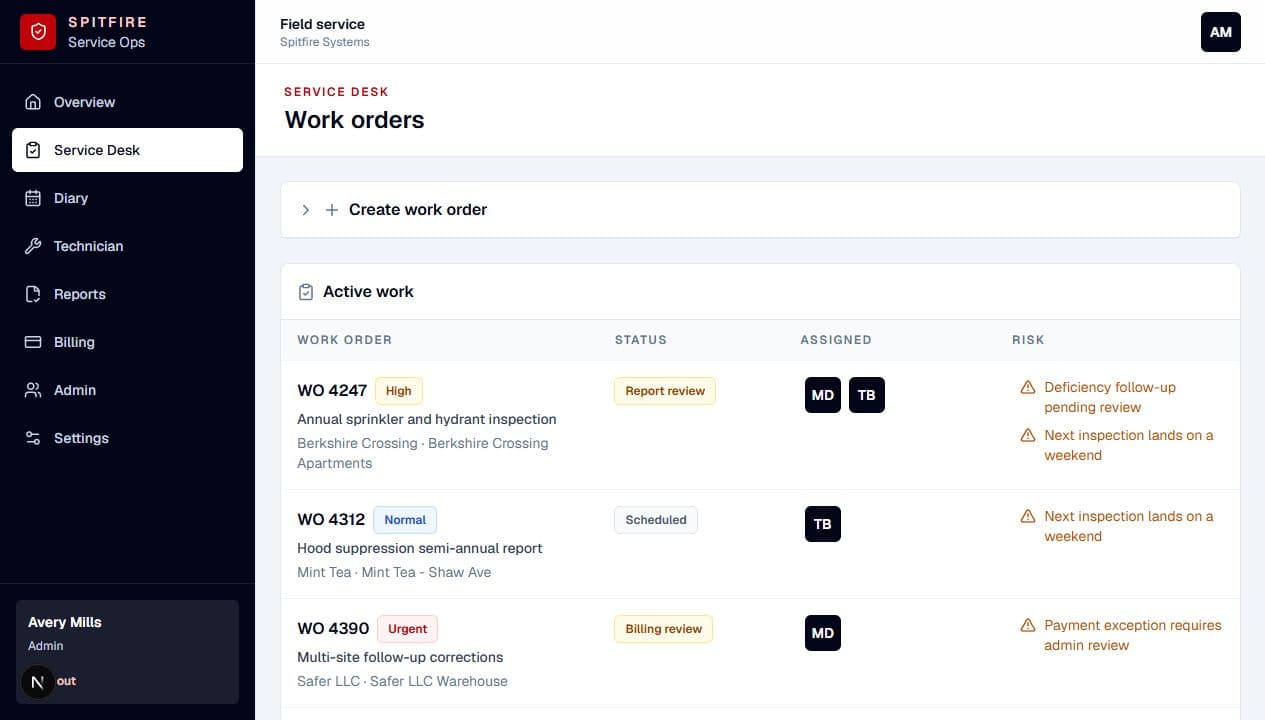
A fire-protection service workflow translated from paper and scanned work-order handling into role-based operational software.
Relevant when
For service businesses that need paper, inbox, technician, review, billing, and admin work turned into one traceable operational system.
System architecture
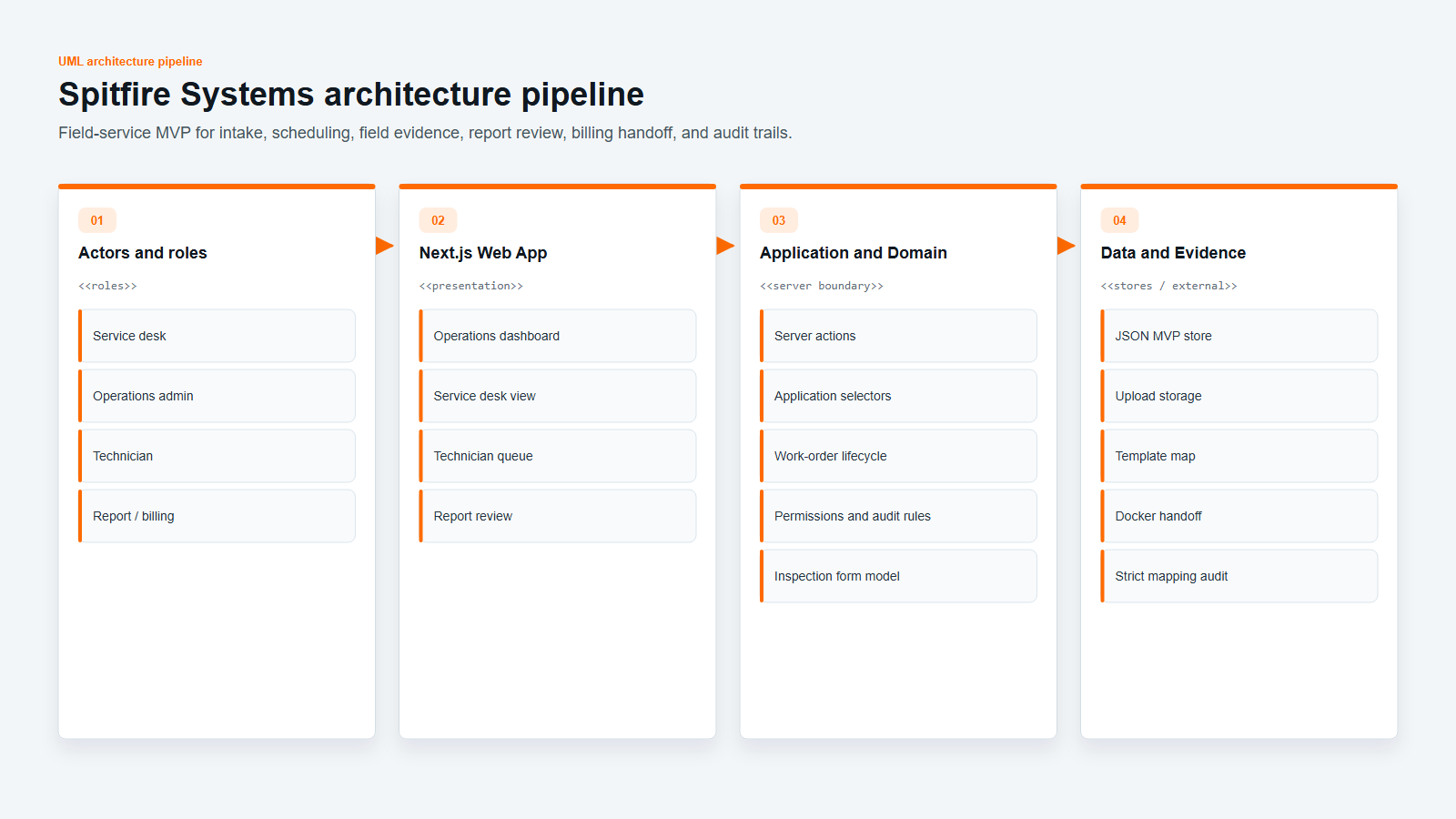
Clean UML pipeline view showing role workflows, Next.js surfaces, application/domain logic, MVP stores, uploads, template mapping, and deployment seams.
Open architecture diagramProject definition
Field-service work moved through fragmented service desk notes, technician activity, inspection forms, report review, billing handoff, and admin audit trails.
Work completed
Theory and context engineering
These are the context-shaping decisions behind the work: how raw domain knowledge, system constraints, AI/tool boundaries, and evidence were turned into useful software behaviour.
Paper forms, service desk notes, report-review steps, billing handoffs, and field activity were translated into explicit roles, states, and work-order transitions.
Digital inspection questions were tied back to source-template references so workflow claims stay auditable rather than becoming undocumented form logic.
Each surface presents the smallest useful context for the actor: service desk queue, technician field execution, report review, billing handoff, or admin audit.
The file-backed store, uploads, audit records, tests, and Docker path preserve enough implementation evidence to review behaviour before committing to production infrastructure.
Skills and stack
Contract proof
Engineering surface
Stack evidence
Hiring relevance
For service businesses that need paper, inbox, technician, review, billing, and admin work turned into one traceable operational system.
User flow
Usefulness
Screenshot evidence
Each image is tied to the project workflow so the gallery explains context, data state, and delivery relevance.
Shows the operational queues and role pipelines that make current work visible at a glance.
Shows active work orders with assignment, status, risk signals, and review ownership.
Shows the field worker view for assigned jobs, job status, receipts, payment, and photo upload readiness.
Shows how completed field work moves into review before customer reporting or billing handoff.
Shows lifecycle state, next action, progress, role ownership, and audit-ready work-order detail.
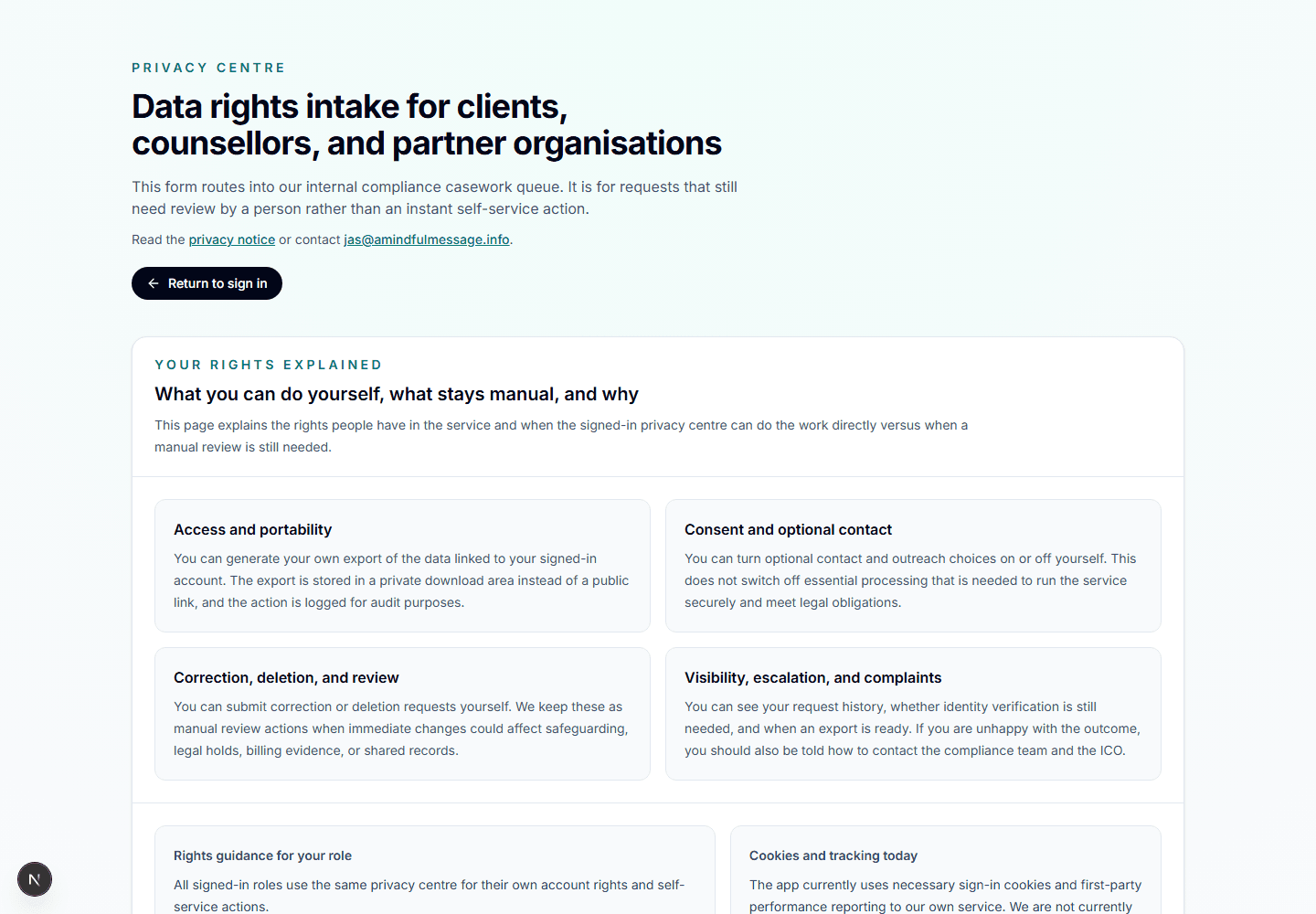
A mental-health referral and counselling SaaS brought through GDPR/HIPAA-oriented implementation, role-aware workflows, privacy operations, hosted evidence, and rollout support.
Relevant when
For founders operating in sensitive domains who need access control, privacy workflows, audit evidence, and launch support handled together.
System architecture
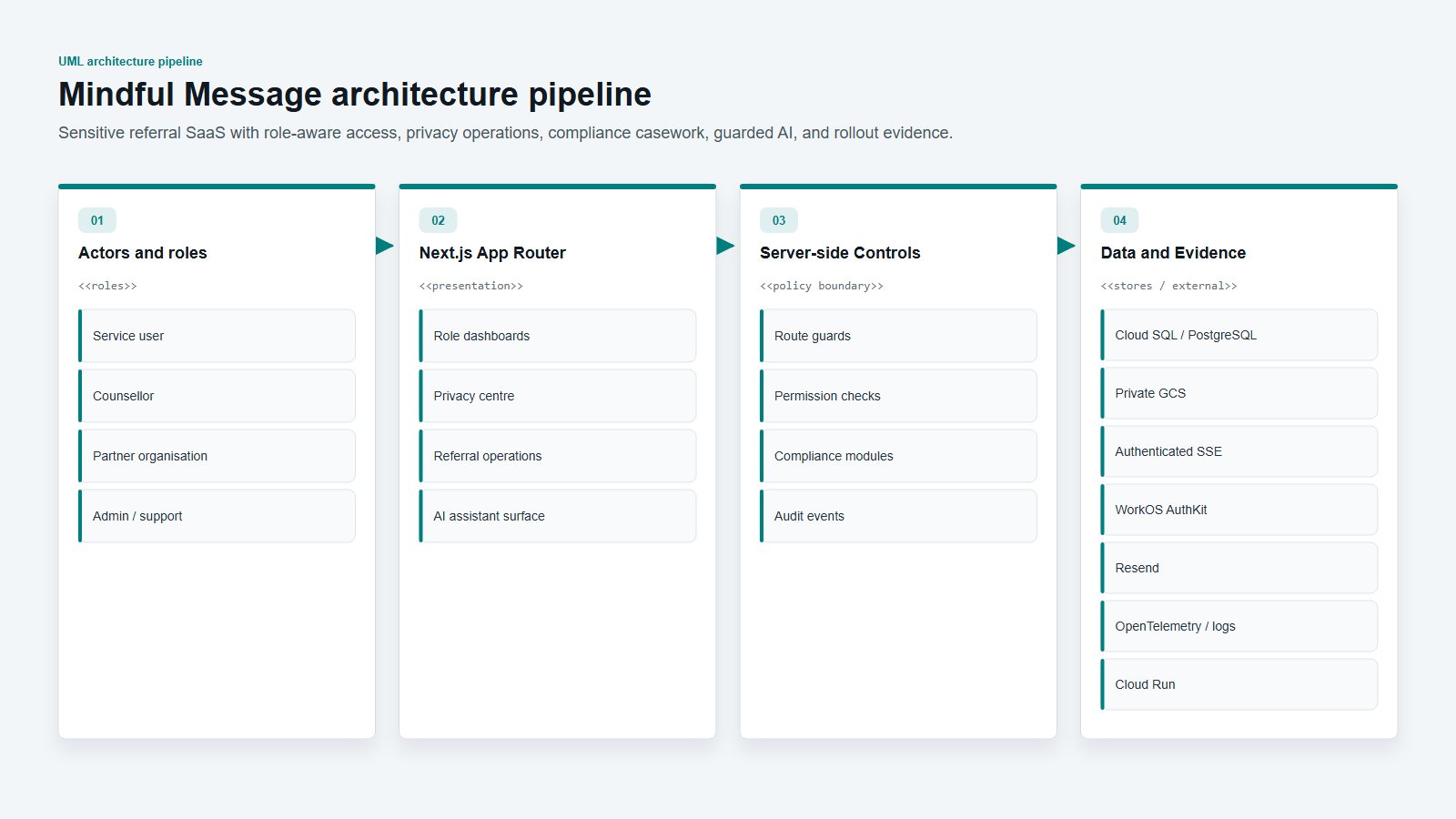
Clean UML pipeline view showing role workflows, protected App Router surfaces, server-side policy controls, WorkOS, Cloud SQL, private storage, event streams, and rollout evidence.
Open architecture diagramProject definition
The founder needed the app made ready for GDPR and HIPAA operating expectations before rollout, across sensitive referral, counselling, assessment, privacy, billing, and reporting workflows.
Work completed
Theory and context engineering
These are the context-shaping decisions behind the work: how raw domain knowledge, system constraints, AI/tool boundaries, and evidence were turned into useful software behaviour.
GDPR, HIPAA-facing expectations, privacy rights, retention, breach, audit, and processor concerns were converted into product workflows and operational evidence.
Role access separates service-user, counsellor, organisation, admin, support, and AI assistant context so sensitive records do not leak into broad operational views.
Privacy requests, DSAR exports, retention holds, breach records, and audit events preserve request state, actor context, due dates, and evidence paths.
Assistant capabilities are framed around server-side permission checks, reviewable tools, human confirmation, and explicit launch limits for clinical or ePHI context.
Skills and stack
Contract proof
Engineering surface
Stack evidence
Hiring relevance
For founders operating in sensitive domains who need access control, privacy workflows, audit evidence, and launch support handled together.
User flow
Usefulness
Screenshot evidence
Each image is tied to the project workflow so the gallery explains context, data state, and delivery relevance.
Shows the privacy route used to explain data-rights intake, manual review, and controlled response handling.
Shows the public intake form for access, export, deletion, correction, disclosure-accounting, restriction, confidential-communications, objection, and complaint requests.
Shows the request receipt path where a submitted privacy case returns a reference and routes into manual compliance casework.
Shows the public privacy notice explaining platform purpose, default role access, support-operator boundaries, and AI assistant limits.
Shows how counsellor, organisation, administrator, support-operator, and AI assistant access boundaries are made explicit for sensitive counselling data.
Shows GDPR lawful-basis and special-category-condition mapping across counselling, authentication, billing, compliance, emails, and telemetry purposes.
Shows retention expectations, individual rights routes, cookie/performance-data limits, complaints guidance, and HIPAA-facing notice language.
Shows the US HIPAA-facing notice language and boundary that separates platform notice wording from customer contract or BAA requirements.
Shows the authentication entry point explaining WorkOS-hosted sign-in, MFA/password-reset support, and the requirement for active role assignment before app access.
Product systems aimed at market gaps, built to demonstrate full-stack web app capability from workflow model to usable interface.
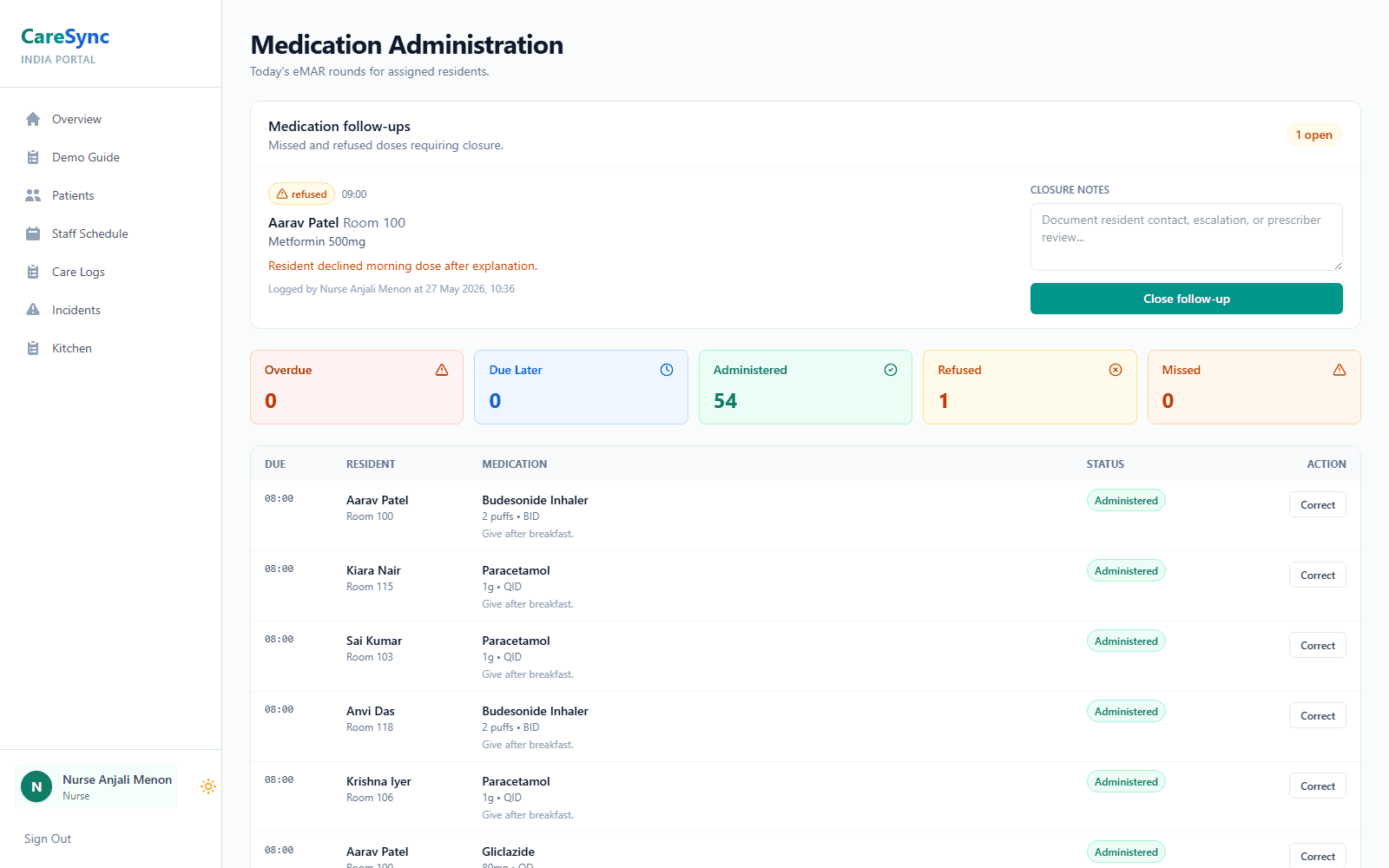
A broad care-home management product prototype covering resident records, clinical workflows, operations, finance, kitchen, incidents, audit, physio, and patient portal surfaces.
Relevant when
For complex multi-role operations where the product value depends on covering the full workflow surface rather than a narrow demo screen.
System architecture
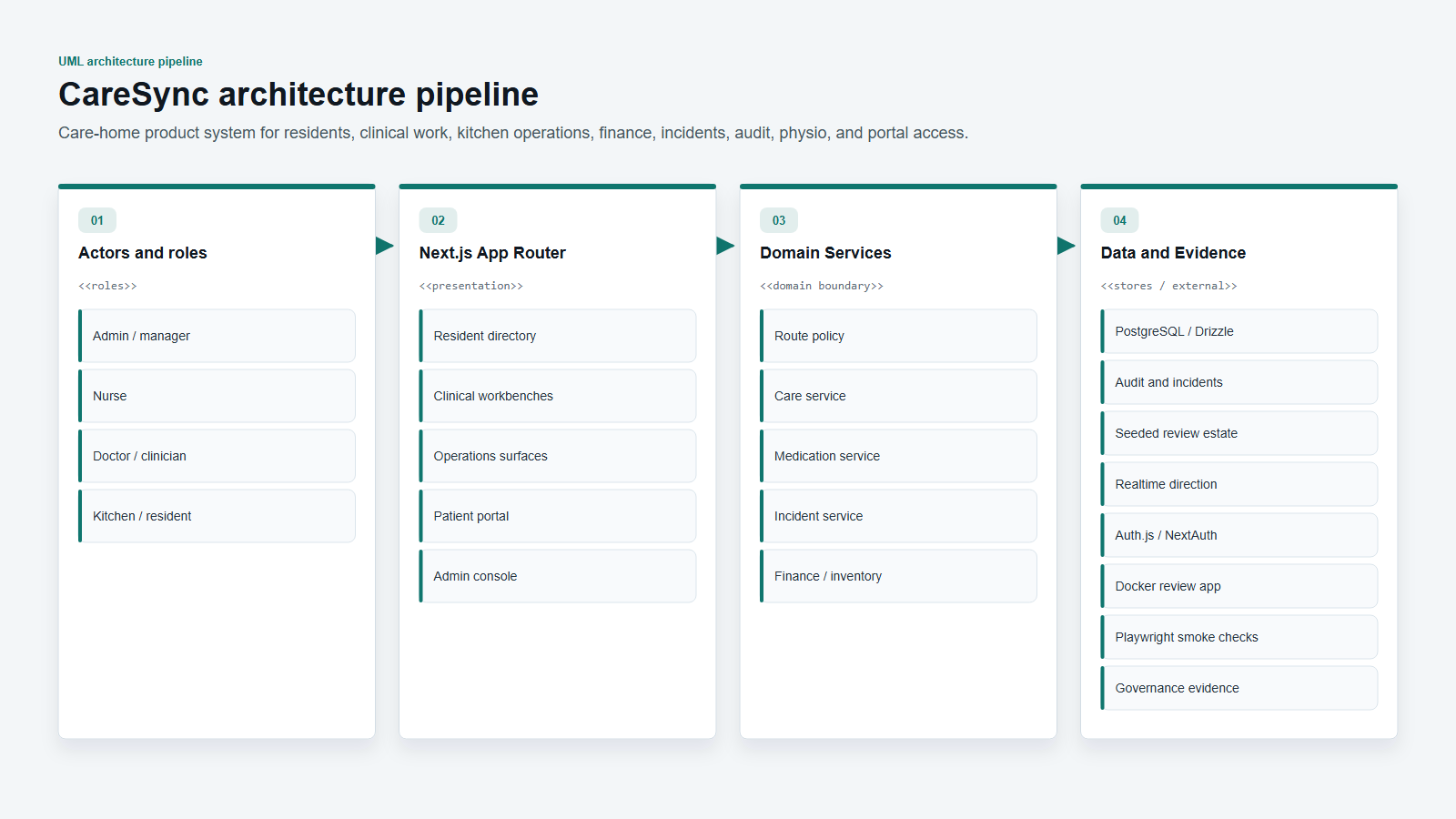
Clean UML pipeline view showing care-home role workflows, App Router surfaces, route policy, domain services, clinical and operations stores, seeded review data, auth, and governance evidence.
Open architecture diagramProject definition
Care operations span many roles and handoffs: admin, nurses, doctors, kitchen teams, managers, residents, finance, compliance, and operational staff.
Work completed
Theory and context engineering
These are the context-shaping decisions behind the work: how raw domain knowledge, system constraints, AI/tool boundaries, and evidence were turned into useful software behaviour.
Resident, medication, doctor, nurse, kitchen, finance, audit, and portal surfaces expose different slices of the same operational domain.
Care records, meal requests, incidents, inventory, finance, vitals, and medication states are modelled as handoffs between roles rather than isolated screens.
Demo accounts, residents, queues, medication states, doctor alerts, kitchen tasks, and audit records make the system reviewable without production data.
Audit, incidents, role policy, assignment checks, and facility scoping keep compliance context visible inside the operating workflow.
Skills and stack
Contract proof
Engineering surface
Stack evidence
Hiring relevance
For complex multi-role operations where the product value depends on covering the full workflow surface rather than a narrow demo screen.
User flow
Usefulness
Screenshot evidence
Each image is tied to the project workflow so the gallery explains context, data state, and delivery relevance.
Shows the resident directory and admin entry point for managing people and care records.
Shows the detailed resident record with clinical context and record lifecycle actions.
Shows nurse-facing eMAR work, due/administered/refused states, resident assignments, and closure queue concepts.
Shows assigned patients, critical alerts, schedule context, and recent clinical activity.
Shows nutrition and meal-service workflow as an operational handoff from care records to kitchen work.
Shows governance evidence for changes, actors, entities, actions, and timestamps.
Research and local AI systems for agentic engineering: retrieval, model workflows, micro-agents, local generation, 3D assets, and evidence capture.
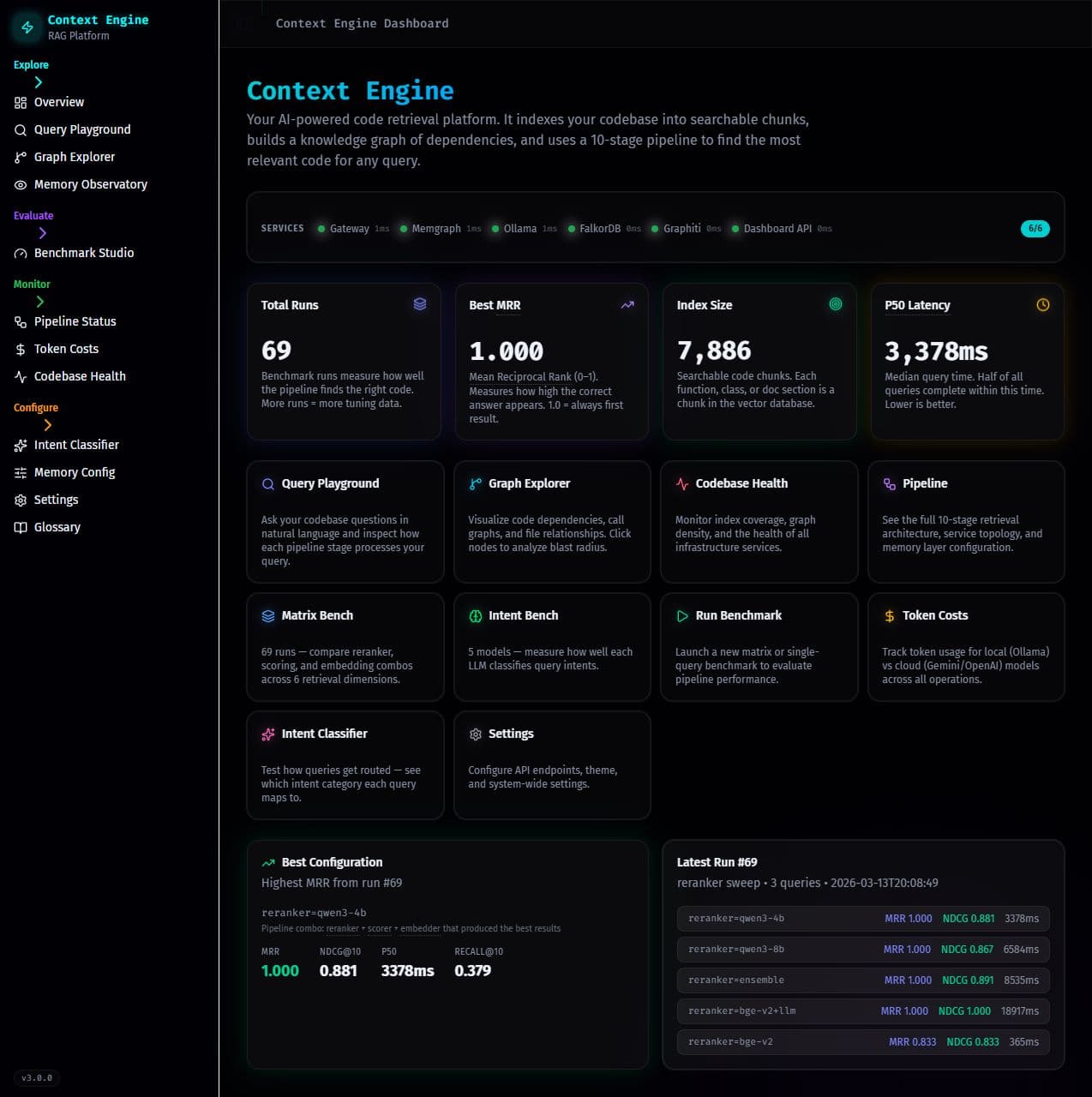
A local GraphRAG and MCP-style context platform for improving coding-agent retrieval, dependency understanding, and reviewable agent work.
Relevant when
For teams exploring agentic engineering who need better retrieval, source-grounded context, dependency awareness, and reviewable agent behaviour.
System architecture
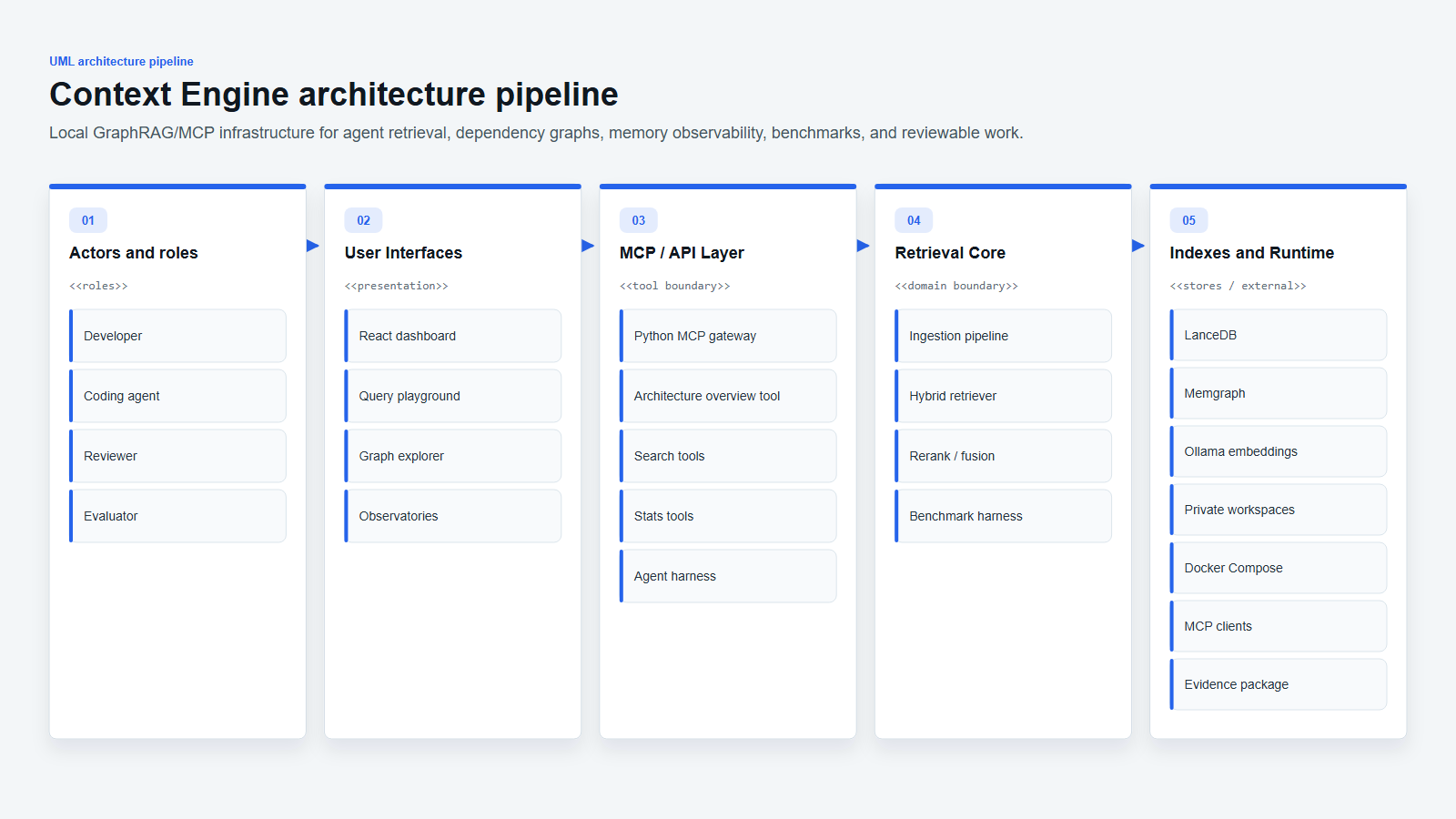
Clean UML pipeline view showing developer and agent workflows, dashboard surfaces, MCP tools, retrieval core, LanceDB, Memgraph, Ollama embeddings, private workspaces, and Docker boundaries.
Open architecture diagramProject definition
Agentic development breaks down when context retrieval is shallow, untraceable, or detached from code structure and dependency relationships.
Work completed
Theory and context engineering
These are the context-shaping decisions behind the work: how raw domain knowledge, system constraints, AI/tool boundaries, and evidence were turned into useful software behaviour.
Vector search, full-text retrieval, dependency graph traversal, reranking, fusion, and memory signals are combined so agents receive grounded context slices.
Files, chunks, functions, classes, methods, imports, calls, and dependency edges are indexed to support blast-radius and architecture questions.
Stage-by-stage diagnostics, score distributions, retained candidates, benchmark matrices, and token-cost views expose why context was selected.
Search, file context, dependency graph, engine stats, and architecture tools turn retrieval into a callable agent capability rather than a passive dashboard.
Skills and stack
Contract proof
Engineering surface
Stack evidence
Hiring relevance
For teams exploring agentic engineering who need better retrieval, source-grounded context, dependency awareness, and reviewable agent behaviour.
User flow
Usefulness
Screenshot evidence
Each image is tied to the project workflow so the gallery explains context, data state, and delivery relevance.
Shows service status, pipeline surfaces, index metrics, and retrieval-operation cards in one local dashboard.
Shows a natural-language code question resolved into ranked chunks, scores, file paths, and retrieval configuration.
Shows the retrieval pipeline breaking a query into stages, score distributions, retained candidates, and ranked code chunks.
Shows file, function, class, and method nodes with dependency and call relationships for blast-radius review.
Shows the Docker-backed services, indexing phase, file and chunk progress, and operational status during a live run.
Shows working-memory concepts, confidence distribution, access patterns, and retrieval-bias signals used to improve agent context.
Shows benchmark runs and retrieval quality metrics across chunking, embedding, reranking, scoring, memory, and fusion configurations.
Shows local-versus-online token usage, estimated cost, and per-stage spend signals for practical agent-infrastructure operation.
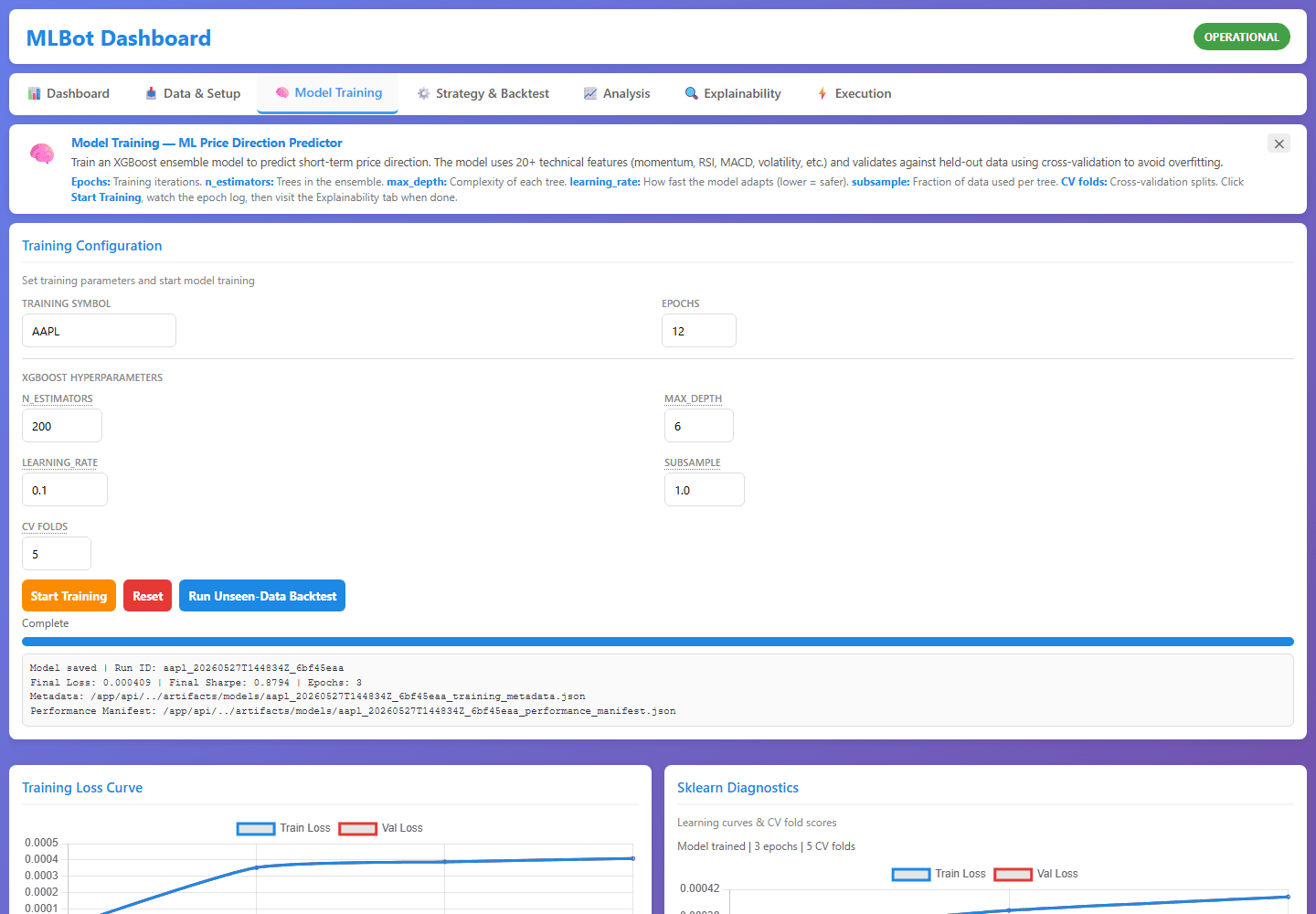
Local AI/ML and quant research tools covering market data, model training, explainability, strategy backtests, run inspection, and paper-webhook workflows.
Relevant when
For research-heavy products where experiments, model output, backtests, generated artifacts, and comparison views need to stay reproducible.
System architecture
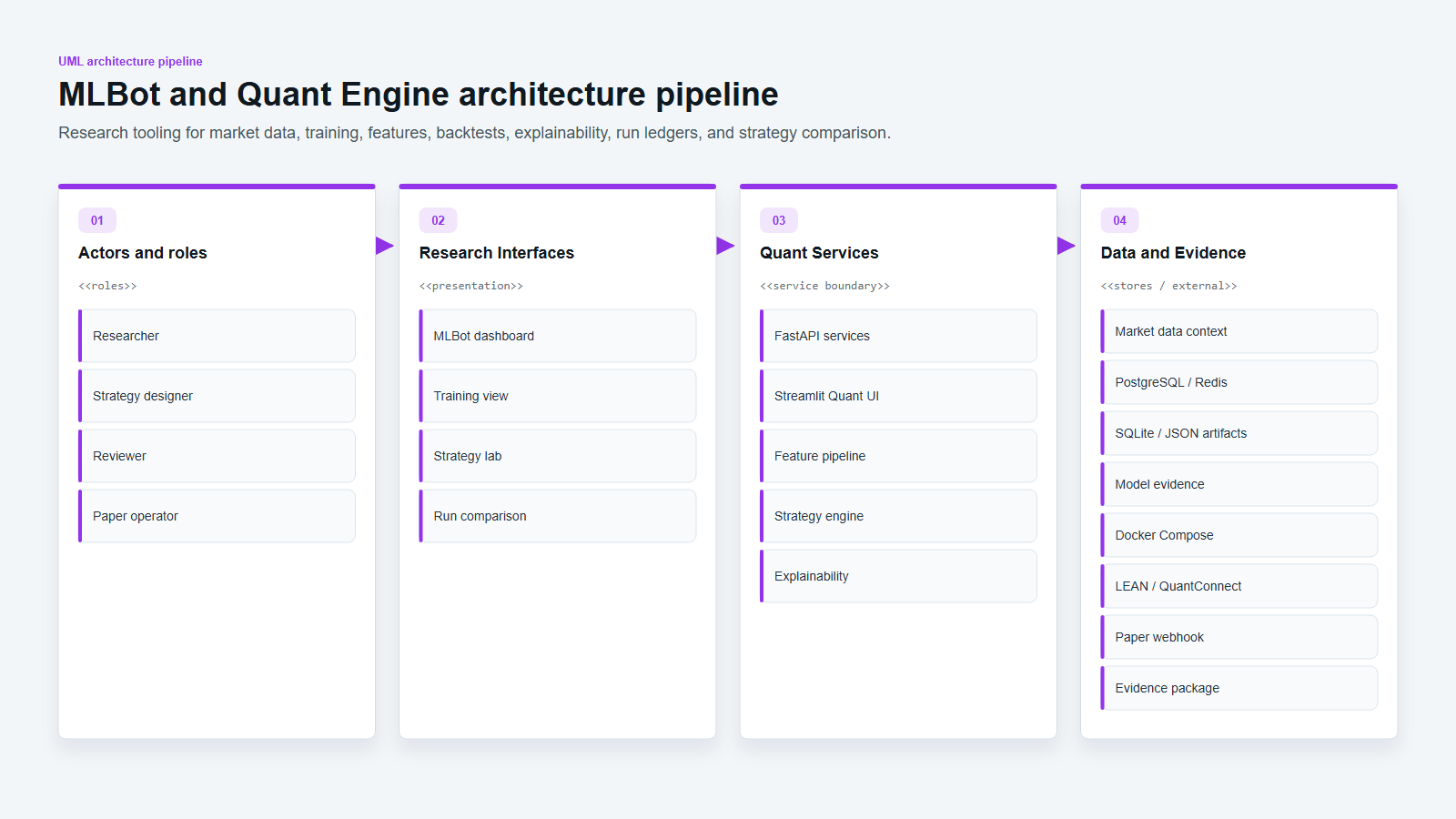
Clean UML pipeline view showing research workflows, MLBot and Quant interfaces, FastAPI and Streamlit services, feature and strategy pipelines, data stores, paper execution, and reproducibility evidence.
Open architecture diagramProject definition
Trading research needs reproducible experiment flow: fetch data, engineer features, train or inspect models, run backtests, compare outcomes, and keep results reviewable.
Work completed
Theory and context engineering
These are the context-shaping decisions behind the work: how raw domain knowledge, system constraints, AI/tool boundaries, and evidence were turned into useful software behaviour.
Runs keep strategy settings, market context, metrics, charts, generated artifacts, and comparison state so results remain inspectable.
Market data, technical indicators, preprocessing windows, labels, model inputs, and backtest assumptions are treated as explicit context objects.
Training curves, metrics, feature importance, prediction context, and strategy outputs make model behaviour reviewable instead of opaque.
Strategy ideas are pushed toward explicit rules, validation, artifacts, and run comparison before any execution or paper-webhook boundary.
Skills and stack
Contract proof
Engineering surface
Stack evidence
Hiring relevance
For research-heavy products where experiments, model output, backtests, generated artifacts, and comparison views need to stay reproducible.
User flow
Usefulness
Screenshot evidence
Each image is tied to the project workflow so the gallery explains context, data state, and delivery relevance.
Shows portfolio-style metrics, chart context, model status, and a local operational dashboard for research workflows.
Shows training configuration, run output, and learning curves from a populated local model workflow.
Shows market-structure analysis and candidate charting used to inspect generated research context.
Shows feature importance and prediction context so model behaviour is inspectable.
Shows strategy configuration, run controls, generated output, and AI-assisted strategy surface.
Shows persisted research runs and artifact selection for reproducibility and comparison.
Shows a generated backtest artifact and chart output from the local strategy workflow.
Shows side-by-side strategy comparison and equity curve review rather than a single unverified score.
Local AI tooling for model serving, TTS, RAG experiments, micro-subagents, 3D asset generation, animation, physics-style scene tests, and browser validation.
Relevant when
For teams that need private local AI workflows, model tooling, retrieval experiments, asset generation, and browser validation on a workstation.
System architecture
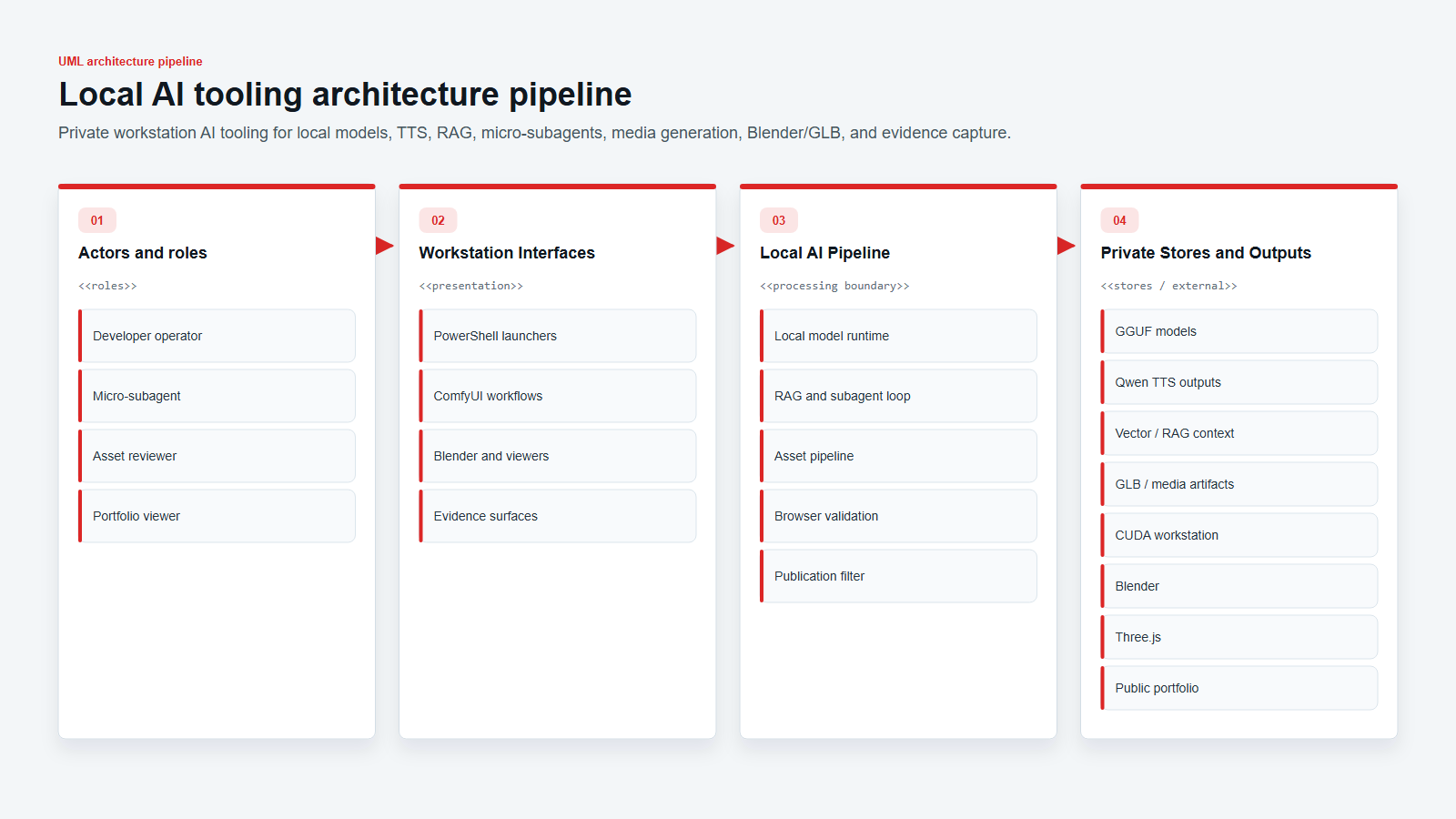
Clean UML pipeline view showing local operators, micro-subagents, workstation interfaces, local model runtime, RAG and asset pipelines, private stores, Blender, Three.js, and publication boundaries.
Open architecture diagramProject definition
AI-native delivery increasingly needs private local tools that can generate assets, run local model tasks, support retrieval, coordinate small agents, and validate outputs on the workstation.
Work completed
Theory and context engineering
These are the context-shaping decisions behind the work: how raw domain knowledge, system constraints, AI/tool boundaries, and evidence were turned into useful software behaviour.
Model serving, RAG, TTS, and asset-generation work are kept on the workstation when privacy, cost, or iteration speed makes local execution useful.
Research, generation, review, and verification tasks are split into bounded agent loops with explicit handoff evidence.
Text prompts, model outputs, generated images, 3D geometry, animation, GLB exports, browser renders, and screenshots become one reviewable workflow.
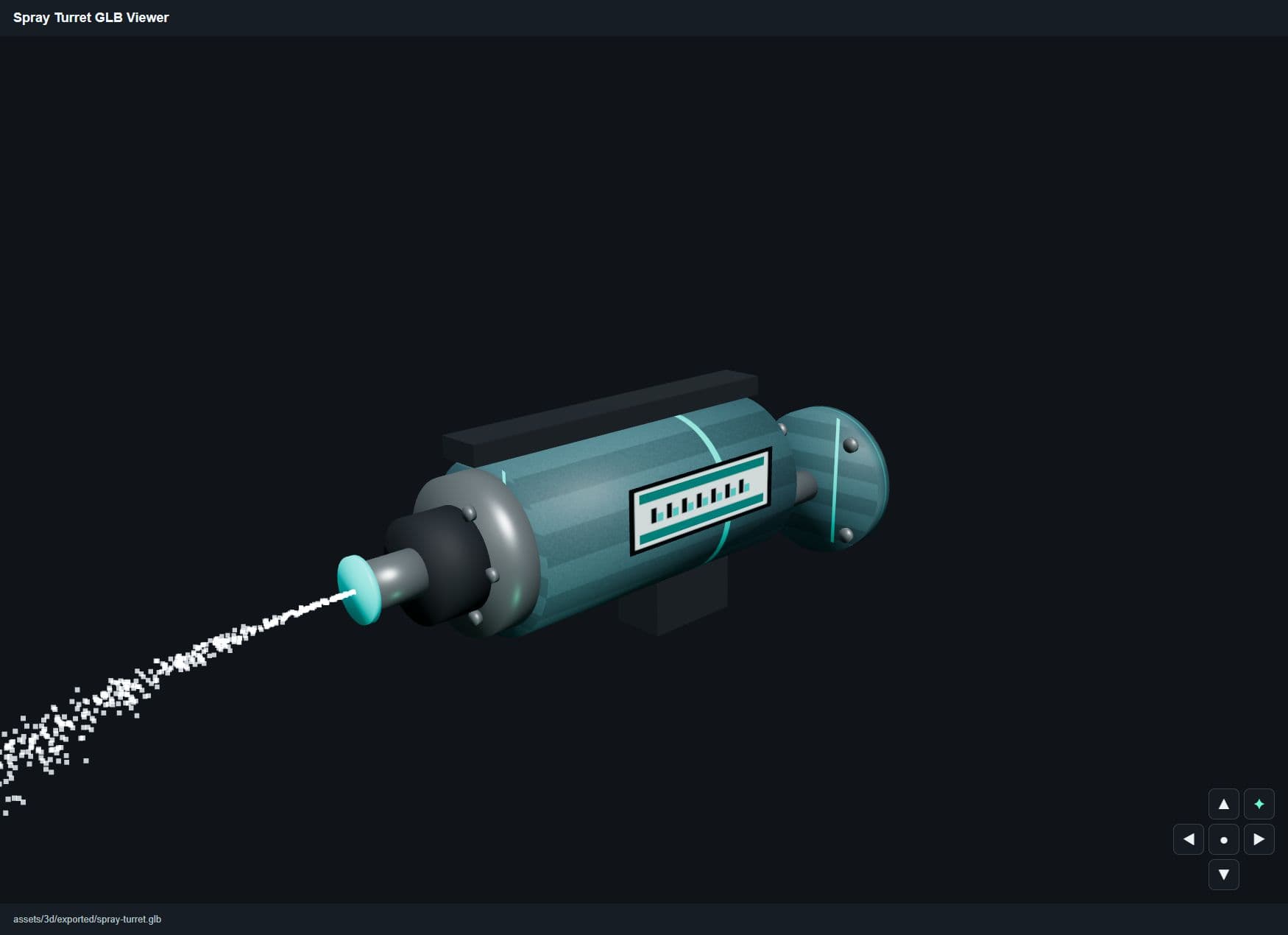
The generated turret scene is inspected in browser viewers to check nonblank render, framing, animation controls, particle-style spray, and physics-oriented behaviour.
Skills and stack
Contract proof
Engineering surface
Stack evidence
Hiring relevance
For teams that need private local AI workflows, model tooling, retrieval experiments, asset generation, and browser validation on a workstation.
User flow
Usefulness
Screenshot evidence
Each image is tied to the project workflow so the gallery explains context, data state, and delivery relevance.
Shows a generated GLB scene used to test modelling, animation controls, particle-style spray, and physics-oriented behaviour in one browser viewer.
Work with FoxTech
The strongest fit is a project where the business process, software architecture, data boundary, or AI workflow needs to move from unclear risk to working, reviewable software.
SocialFox AI social operations command centre
An AI-native social media command centre for content operations, unified inbox triage, audience intelligence, analytics, and provider connections.
Relevant when
For product teams that want AI embedded into real operator workflows, with provider integrations, analytics, inbox triage, and review before action.
System architecture
How the system is put together
UML AI social operations architecture pipeline
Clean UML pipeline view showing operator workflows, command-centre surfaces, typed API contracts, FastAPI services, provider registry, data stores, AI context packs, and social integrations.
Open architecture diagramProject definition
What problem this solves
Creators, agencies, and social operators manage posts, comments, reporting, audience signals, and channel connections across too many disconnected tools.
Work completed
What was built
Theory and context engineering
Techniques used in this project
These are the context-shaping decisions behind the work: how raw domain knowledge, system constraints, AI/tool boundaries, and evidence were turned into useful software behaviour.
Provider-context abstraction
Platform-specific OAuth, account identity, capabilities, metrics, messages, and limits are normalized behind typed provider boundaries.
Operator-context composition
Dashboard, inbox, content, audience, and analytics views combine platform signals into the context a social operator needs at the point of action.
Human-in-the-loop AI workflow
Assistant and content-generation concepts are framed as draft, analyse, review, and approve loops rather than automatic publishing.
Signal-to-action modelling
Engagement, audience, content, and conversation signals are structured so they can drive triage, content planning, and reporting decisions.
Skills and stack
Engineering capability shown
Contract proof
What this proves about FoxTech delivery
Engineering surface
Stack evidence
Hiring relevance
For product teams that want AI embedded into real operator workflows, with provider integrations, analytics, inbox triage, and review before action.
User flow
How someone moves through it
Usefulness
Why the work matters
Screenshot evidence
Workflow and implementation evidence
Each image is tied to the project workflow so the gallery explains context, data state, and delivery relevance.
Dashboard
Shows audience, lifetime views, activity, top engagers, and channel context in one operating view.
Content studio
Shows multi-platform content cards and the workspace for planning or drafting social output.
Inbox
Shows the conversation triage surface where social comments and messages become reviewable work.
Audience intelligence
Shows CRM-style audience rows, engagement tiers, and segmentation concepts.
Analytics
Shows cross-platform performance panels intended to turn raw metrics into operating insight.
Connections
Shows provider connection cards and OAuth-oriented account management surfaces.